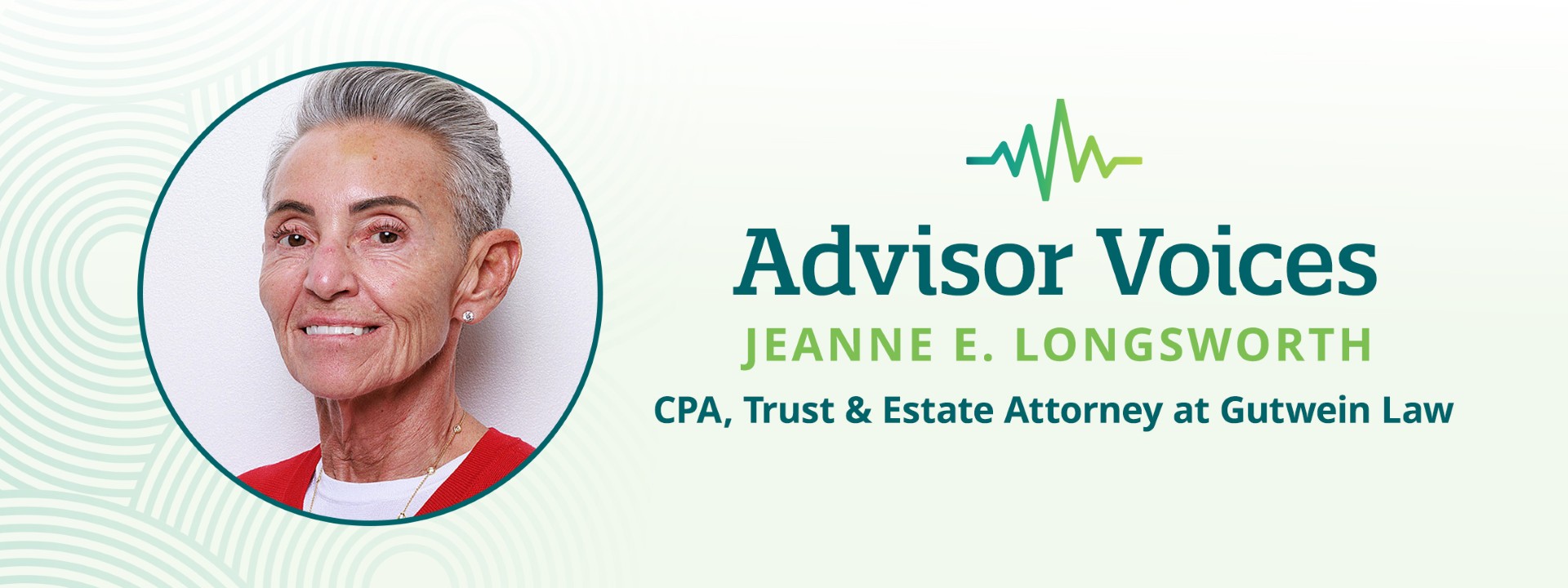
How many years have you been in practice? What is your focus area, and why do you enjoy estate planning?
When I started practicing law 39 years ago, I was fortunate to find my niche right away. From day one, I focused on estate and succession planning, as well as estate and trust administration. I continue practicing in those areas principally because of the long and lasting relationships I have with clients. I am pleased to say that I’ve worked with numerous clients for 25 years or more. In fact, I now work with the children and grandchildren of a matriarch and patriarch for whom I prepared a family buy-sell agreement and other estate planning documents during my first year of practice.
What are some of the biggest misconceptions clients have about charitable giving as part of an estate plan?
Misconception: small amounts don’t make a real difference because philanthropy is only for people who can donate thousands (or millions) of dollars.
Reality: large donations get a lot of attention and can be a “game changer” for a smaller organization; however, all donations are important to a nonprofit organization. Even modest donations provide meaningful impact when combined with the generosity of others. Many nonprofits depend heavily on modest gifts from a large number of supporters to survive and further their mission. Recurring small donations – such as monthly contributions – provide predictable funding that allows an organization to plan programs and expand services. Further, small gifts also play a significant role in funding grassroots initiatives and emerging nonprofits that have not yet attracted major donors.
Misconception: there are not any tax benefits for making a charitable gift.
Reality: most donations to 501(c)(3) nonprofit organization are deductible for income tax purposes and federal estate and gift tax purposes. Beginning in 2026, non-itemizers can deduct up to $1,000 in cash gifts ($2,000 for joint filers) on their personal income tax returns. For itemizers, gifts of stock or real property may offer better value than a cash gift because a gift of stock or real property generally produces an income tax deduction equal to the fair market value of the stock or real property on the date of the gift and, as an added bonus, the donor does not recognize any built-in capital gains. Further, in 2026, a taxpayer who is 70-1/2 years or older can exclude up to $111,000 ($222,000 for married couples) for direct donations from a traditional individual retirement account (IRA) to qualified charities without itemizing deductions. If the taxpayer has reached the age at which Required Minimum Distributions from the IRA are mandatory, the transferred amount is not included in his adjusted gross income, which can lower income tax due on Social Security benefits and reduce Medicare premiums.
Misconception: if I want to make a large, lasting impact, I should establish and fund a private foundation.
Reality: private foundations can play a role in making a significant impact over time. However, many donors are finding similar (or better) tax and impact benefits by using donor advised funds instead of creating a private foundation. These “personal giving accounts” are established at public charitable organizations, such as the Community Foundation. They do not require the same legal work needed for a foundation nor are they controlled in the same manner as a foundation (i.e., by its board). Because a donor advised fund is reported on the information return filed by the public charitable organization that holds the funds, a donor advised fund does not incur the expense attributable to filing its own tax return. Also, unlike private foundations, a donor advised fund is not subject to the required minimum annual distributions rules.
Charitable giving is often an important part of a client’s legacy. Philanthropy is deeply personal. How do you begin these conversations with clients?
Most often, clients reveal their charitable intentions naturally during our initial estate planning meeting. As we talk about family, work and personal interests, they may mention a church they regularly attend, an organization that has been meaningful to them or simply a desire to give back.
The conversation may also arise when we discuss how they would want their estate distributed if none of their named beneficiaries survive them. If charitable giving has not come up by the end of our meeting, I simply ask the question directly. Sometimes, that straightforward question opens the door to a thoughtful conversation about the causes and organizations they care about most.
Can you share a memorable example (without identifying the client) of how charitable planning helped a client accomplish something that was especially meaningful to them?
During her lifetime, an unmarried, childless public-school teacher lived very frugally. By the mid-90s, she had amassed almost $1 million. While she wanted to remember her niece, her niece’s children (all of whom were under 21 years of age), and several friends in her last will, she did not want them to receive her entire estate. Instead, because she wanted to avoid the 55% federal estate tax on estates over $600,000 and the 10% Indiana inheritance tax payable on bequests to non-immediate family members, she decided to leave the bulk of her estate to charity. However, because she feared a few of her intended charities might use their bequests to develop programs that they could not support for the long-term, she wanted to avoid outright distributions to the charities. After discussing the pros and cons of establishing and administering a private foundation, she moved forward to creating a private foundation. Today the foundation’s assets total more than $1.6 million and its board includes her niece and her niece’s children. Since its full funding in the mid-90s, the foundation has distributed at least $60,000 annually (or a total of $1.8 million) to charities that were important to and supported by the foundation’s founder prior to her death. Also, to teach and encourage the next generation, the oldest of which is now 14 and the youngest of which is now 8, about philanthropy, the board allots $2,000 to each “junior member” every year. Each junior member is charged with identifying one or more charities who will share his $2,000 allotment and then sharing with the board his charities’ mission and why he selected his charities. Each junior member is further charged with delivering his allotment to his selected charities.
Tell us about your experience with the Community Foundation and why you’d refer clients to us.
My introduction to the Community Foundation of Greater Fort Wayne was in 1988 when I worked with Barbara Burt to develop the parameters of a scholarship fund the Community Foundation was going to administer for a client. Thereafter, I continued to refer clients to the Community Foundation because it was both genuinely invested in Allen County and a great steward of the gifts entrusted to it. From 1995 – 2001, I became more intimately familiar and involved with the Community Foundation when I had the privilege of serving on its Board of Directors and as its President from 1999 – 2001. Fast forward to today, the number of faces at the Community Foundation and its total assets have grown exponentially while remaining steadfast to its mission to Imagine Greater.